
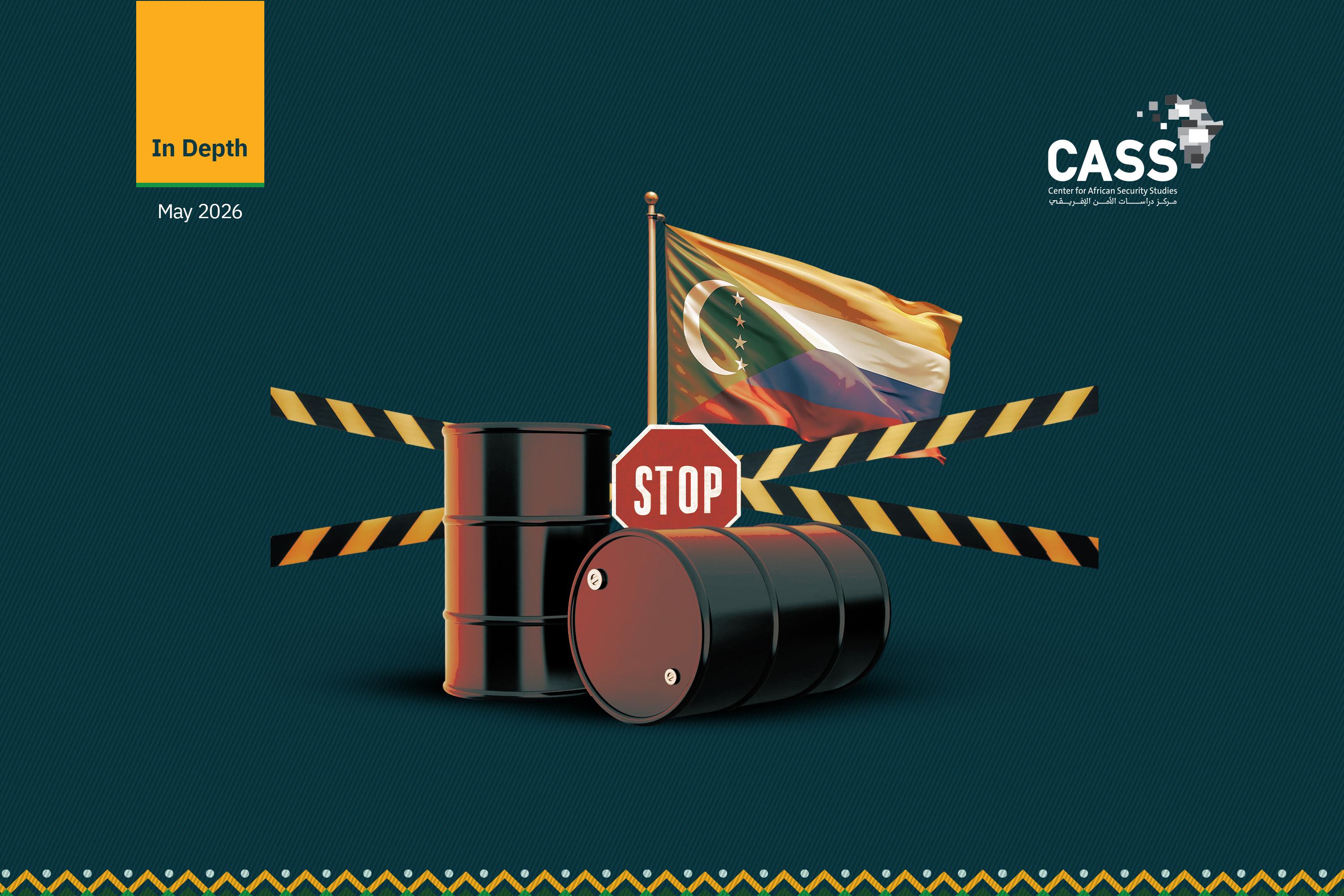
Since May 12, 2026, the Comoros has been experiencing a near-total paralysis of its vital sectors, following the outbreak of a broad general strike led by the transport sector in protest against a government decision to raise fuel prices — a step the authorities justified by citing rising import costs and growing fiscal pressures on the public budget. The decision comes in the context of a wave of global increases in energy and maritime shipping prices over recent months, particularly following oil market disruptions linked to tensions in the Middle East and international shipping lanes.
The strike began in the capital Moroni before rapidly spreading to most areas of Grande Comore, with mounting indications that the movement is extending to the islands of Anjouan and Mohéli.
The work stoppage by bus drivers, taxi operators, and freight vehicle drivers has led to a near-complete freezing of daily movement, the disruption of schools and educational institutions, and a partial paralysis of government departments as employees are unable to reach their workplaces.
The repercussions of the crisis have extended to the commercial sector, with the central Volo Volo market — the largest in the capital — witnessing a partial closure in response to union and popular calls to broaden the commercial strike. This reflects the gradual transformation of the crisis from a limited livelihood protest into a broader social movement carrying increasingly political dimensions.
This development cannot be separated from the economic and social accumulations the country has been suffering for years. The Comoros relies almost entirely on imports to meet its food and fuel needs, making it acutely vulnerable to global fluctuations in energy and maritime shipping prices. The country also suffers from a weak productive base, high unemployment rates — particularly among youth — alongside an erosion of purchasing power driven by persistent inflation and rising living costs.
The decision to raise fuel prices appears to have come at a highly sensitive moment, amid a growing popular sense that the government is transferring the burden of the economic crisis onto citizens without offering commensurate social protection measures. The crisis has coincided with escalating criticism directed at executive circles close to the authority — particularly regarding the expansion of the powers of exceptional committees attached to the government's general secretariat, which segments of the opposition and civil elites view as a tool for concentrating political and economic power while weakening oversight and constitutional institutions.
Politically, the strike has demonstrated a notable capacity by the opposition — both inside and outside the country — to coordinate on the ground and in the media, capitalizing on widespread popular frustration. Some of the slogans raised have gone beyond immediate economic demands to call for a change of government and the organization of early presidential elections, suggesting that the livelihood crisis could transform into a direct political challenge to the regime.
In response, the crisis has revealed divergences within ruling circles over how to handle the protests. While the security wing is pushing for tighter measures and the arrest of activists and union leaders to prevent the expansion of the movement, the presidency appears more cautious about the use of force — fearing that direct repression could trigger a broader explosion of protests that would be difficult to contain, particularly given the sensitive geographical and political nature of the archipelago, which has historically experienced tensions and divisions among its different islands.
The crisis also raises concerns over broader security and economic repercussions. A continued disruption of transport and trade could lead to supply chain disruptions and further increases in the prices of basic commodities, potentially pushing new social sectors to join the protests. Furthermore, any wide-scale security deterioration could impact maritime stability and irregular migration in the Indian Ocean region, particularly given the country's geographic proximity to Madagascar, Mozambique, and the French territory of Mayotte.
Based on current dynamics, the crisis appears likely to evolve along one of three main scenarios.
The first is a government retreat and temporary settlement, which assumes that presidential or union-led mediation succeeds in reaching a partial agreement — through a temporary suspension of the price hike decision or the provision of direct support to the transport sector — thereby allowing the strike to end and the political momentum of the protests to be contained.
The second scenario is gradual escalation and civil disobedience, premised on the government maintaining the new prices, which would push unions and commercial federations to expand the strike to cover all three islands — with popular demonstrations intensifying and the political ceiling of demands widening — potentially placing the regime before a deepening legitimacy crisis.
The third scenario assumes that the authorities resort to targeted arrests of movement and union leaders, combined with security and media restrictions to contain the protests. While this option may temporarily succeed in reducing field activity, it carries high risks of generating a chronic state of tension that could reignite the crisis at a later stage in a sharper form.
Overall, the current crisis reveals that the Comoros is facing a sensitive internal test that goes beyond a mere dispute over fuel prices — reflecting the fragility of the economic structure and the weakness of trust between the public and the authority, at a time when the government's capacity to absorb popular anger appears limited. This makes the coming weeks decisive in determining the direction of political and social stability in the archipelago.