
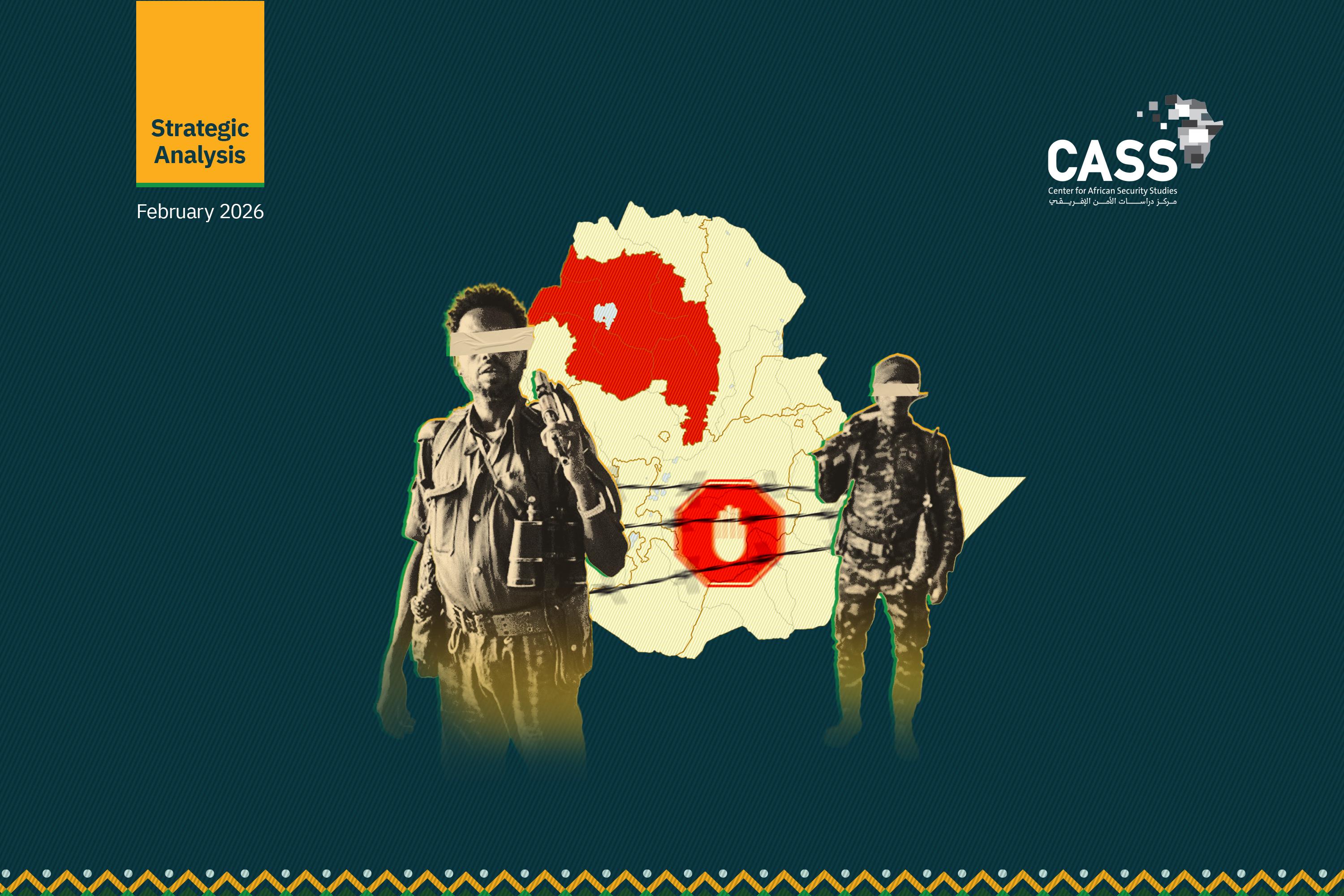
The conflict in Amhara, Ethiopia’s second-most-populous region, entered an uneasy stalemate in early 2026. Nearly three years into an armed rebellion sparked by the federal government’s April 2023 decision to dissolve regional forces and centralize the security services, the federal army has failed to achieve an outright military victory. Conversely, the Fano rebel movement has also proven unable to capitalize on its dominance of the countryside in order to offer a stable political alternative.
The Fano rebel group currently controls large swathes of the countryside in Gojjam, Gondar, and Wollo, while the federal army maintains its hold over major urban centers (Bahir Dar, Gondar, and Debre Berhan) and strategic roads, despite being the target of repeated hit-and-run attacks.
The Ethiopian army has shifted to a heavy reliance on drones to make up for the depletion of its ground forces. This has resulted in civilian casualties and deepened the bitter rift between the central government and the Amhara ethnic group.
Over the final months of 2025 and in early 2026, Fano made frantic efforts to stem the fragmentation of its leadership, which has plagued the group since its inception as a decentralized grassroots movement. There were three prominent unification attempts: the “Field Command Initiative” in Gondar, the “Diaspora Conference”—held virtually to provide political cover—and an attempt to form a “Unified Amhara Consultative Council.”
These efforts culminated in the unveiling of the Amhara Fano National Movement (AFNM), which included the group’s four main factions from Gojjam, Gondar, Wollo, and Shewa. For the first time, this coordination body succeeded managed to agree a unified political document outlining the region’s demands—most notably the abolition of the current ethnic federal system.
Yet this partial, local success has not translated into more comprehensive political progress. On the ground, it has conducted simultaneous attacks against the federal army in disparate areas. However, in political terms, a gap remains between the younger leadership inside the country, who reject any negotiation, and the “old guard” in the diaspora, who seek a political solution that preserves the Amhara’s gains.
Concurrently, the conflict in Amhara has transformed into a small-scale proxy war in which local interests are intertwined with the ambitions of regional players.
Locally, Fano enjoys broad popular support from Amhara nationalists, who see it as the only bulwark against expansion by the Oromo, the largest ethnic group in Ethiopia. Fano is also supported by some former members of the Amhara region’s ruling Prosperity Party, who have defected or secretly sympathize with nationalist demands.
Eritrea is the group’s main logistical supporter. Asmara sees weakening Addis Ababa as a key strategic interest and a way to hinder any Ethiopian bid to gain access to the Red Sea. Fano also relies heavily on funding from the Amhara diaspora in the U.S. and Europe, who funnel millions of dollars to the group through unofficial channels to allow it to buy weapons and ammunition on the black market in Sudan and across the Sahel.
Conversely, the army enjoys the support of political factions and militias linked with the Oromo, as well as support from some minorities within the Amhara region who fear a return to the historical dominance of the Amhara.
What next?
Based on where things stand data, three scenarios are likely in 2026:
1.Protracted attrition. In this scenario, the situation would remain at a stalemate: rural pockets of insurgency and fortified urban centers held by federal forces. Given the army’s inability to achieve a decisive victory due to the combination of rugged terrain and popular support for Fano, alongside the rebels’ inability to enter and hold major cities, this is the most likely scenario.
2. A partial peace agreement. Under this scenario, Addis Ababa would sign agreements with certain Fano factions, akin to certain initial understandings reaching in December, in exchange for their integration into local government and a role in securing areas disputed with Tigray. This scenario is underpinned by certain Fano commanders’ desire for political legitimacy, and by pressure from international mediators (notably the African Union and IGAD).
3. Comprehensive escalation, regional collapse. In this scenario, the fighting could spread to Addis Ababa itself, or sever the vital supply route from Djibouti. This would be more likely were the Fano to coordinate successfully with Oromo Liberation Army (OLA) rebels to strangle the central government. However, this is unlikely due to the deep ideological and ethnic differences between the Amhara and Oromo, which would render any alliance between them tactical and fragile.