
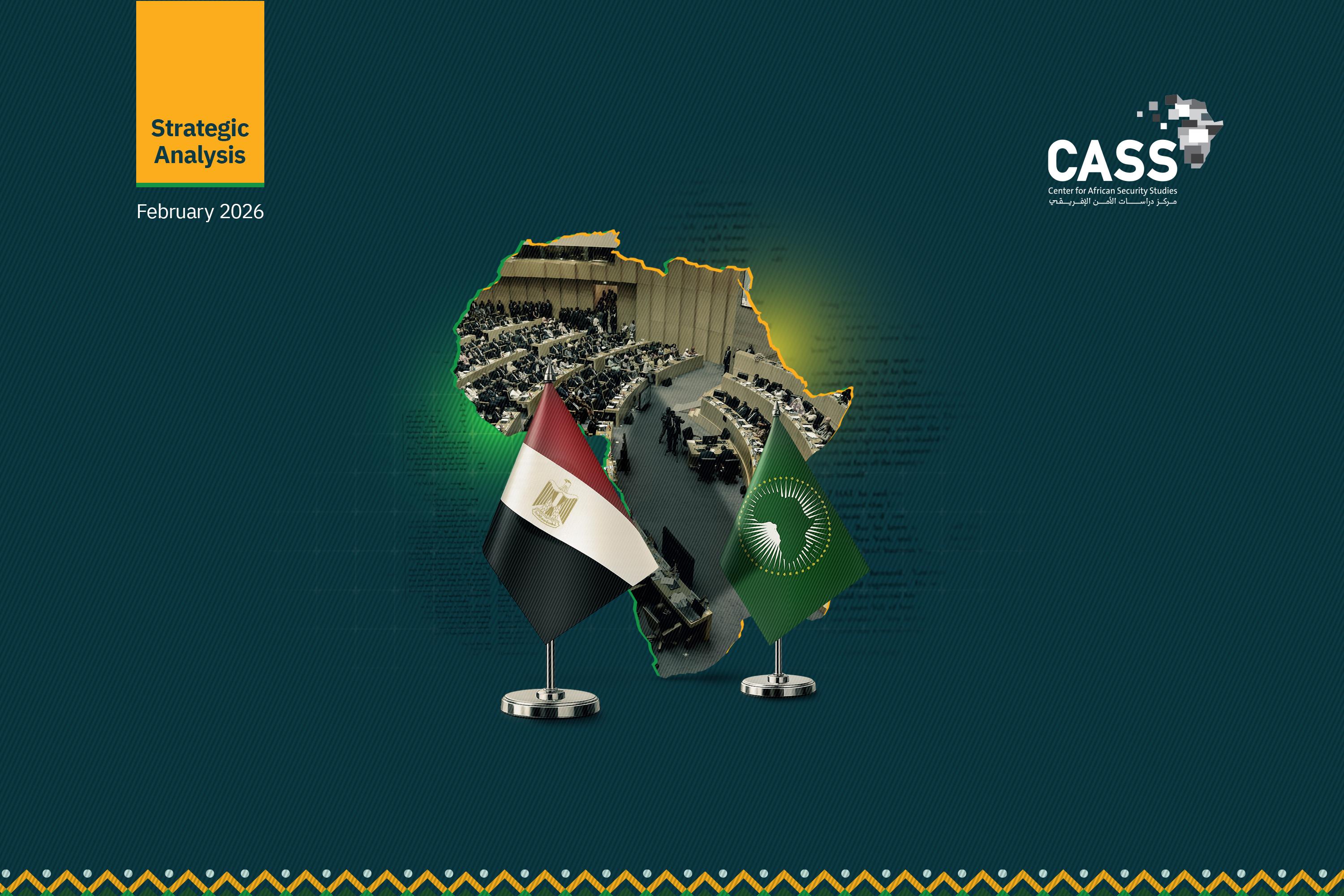
Egypt stepped up to the presidency of the African Union’s Peace and Security Council in early February, as the continent grapples with an unprecedented escalation in armed conflicts and political crises.
The Council oversees the AU’s efforts to prevent, manage and resolve conflicts, and is the cornerstone of Africa’s peace and security architecture.
Holding the rotating presidency grants Egypt the authority to formulate the Council’s agenda, manage consultative sessions, and direct the AU’s efforts on specific issues, giving it unrivalled clout in shaping African responses to contemporary crises.
Egypt places paramount importance on the role, which provides it with a legitimate, legal platform to defend its national security. This in turn is intrinsically linked to the stability of Cairo’s sphere of influence in the Nile Basin, the Horn of Africa, and across North Africa.
Through its presidency, Egypt will seek to strengthen its role as a regional leader capable of proposing “African solutions to African crises,” thereby reducing external interventions whose interests may conflict with Egypt’s fundamental national security concerns.
The presidency also provides Egypt with an opportunity to garner support from across the continent for its positions on key issues, most notably water security and the military balance in East Africa, as well as enhancing the role of Egyptian companies in reconstruction projects in conflict zones.
During its presidency, Egypt is likely to focus its efforts on four main issues:
·The Sudan Crisis: Prioritizing Sudan by attempting to activate African-led initiatives and coordinating efforts among neighboring countries to prevent the collapse of state institutions, with a focus on the humanitarian situation and achieving a permanent ceasefire.
·The Horn of Africa and Somalia: Supporting Somalia’s sovereignty and territorial integrity, especially in light of its tensions with Ethiopia regarding access to the Red Sea, and working to strengthen the Somali army’s ability to confronting Al-Shabaab militants as the mandates of international missions draw to a close.
·Counterterrorism in the Sahel: Transferring Egyptian counterterrorism expertise to West African and Sahel countries, and providing technical and logistical support to counter the expansion of armed groups, following the withdrawal of traditional international forces from the region.
· Reconstruction and Development: Leveraging the AU’s Centre for Post-conflict Reconstruction and Development (PCRD)—which is headquartered in Cairo—to shift the focus from simply “silencing the guns” to a phase of sustainable reconstruction and development to prevent conflicts from recurring.
Egypt is pushing for implementation of the second 10-year plan under African development blueprint Agenda 2063, with a focus on infrastructure and continental connectivity projects, such as the Cairo-Cape Town highway and electricity interconnection projects, as tools to enhance interdependence among African countries and reduce the likelihood of armed clashes.
Egypt’s support for the PCRD represents the practical application of this convergence. The center serves as a mechanism for translating Agenda 2063 into real-world programs to support post-conflict countries, thus promoting sustainable peace through economic and social development.
Agenda 2063 aims to transform the continent into a global power through inclusive, sustainable development. It is based on seven key aspirations, including prosperity, political integration, good governance, peace and security.
Egypt’s presidency of the Peace and Security Council faces a number of structural and operational challenges, most notably a sharp polarization within the continent over certain conflicts, which could hinder efforts to reach a consensus among the body’s members.
The AU’s shortage of financial resources also presents a significant obstacle, as peacekeeping operations and military interventions remain heavily reliant on external funding, thus restricting the independence of African decision-making.
Furthermore, the existence of multiple overlapping initiatives (such as by the Intergovernmental Authority on Development or IGAD, the Organisation of Islamic Cooperation or OIC, and other international bodies) presents a challenge for Cairo as it seeks to unify efforts under the umbrella of the AU.
Rapid transformations in the Sahel region and the emergence of new military alliances outside the structure of the ECOWAS regional bloc have also imposed a complex geopolitical reality that is difficult to address using traditional diplomatic tools.
Egypt’s success in its presidency will depend primarily on its ability to balance its role as an impartial mediator in continental conflicts with the protection of its own direct national interests.
Cairo is likely to focus on quiet diplomacy and building bilateral alliances within the Council, to ensure the passage of resolutions that support the structural stability of African nation-states, while simultaneously attempting to push the international community to offer unconditional financial and technical support for African security initiatives.