
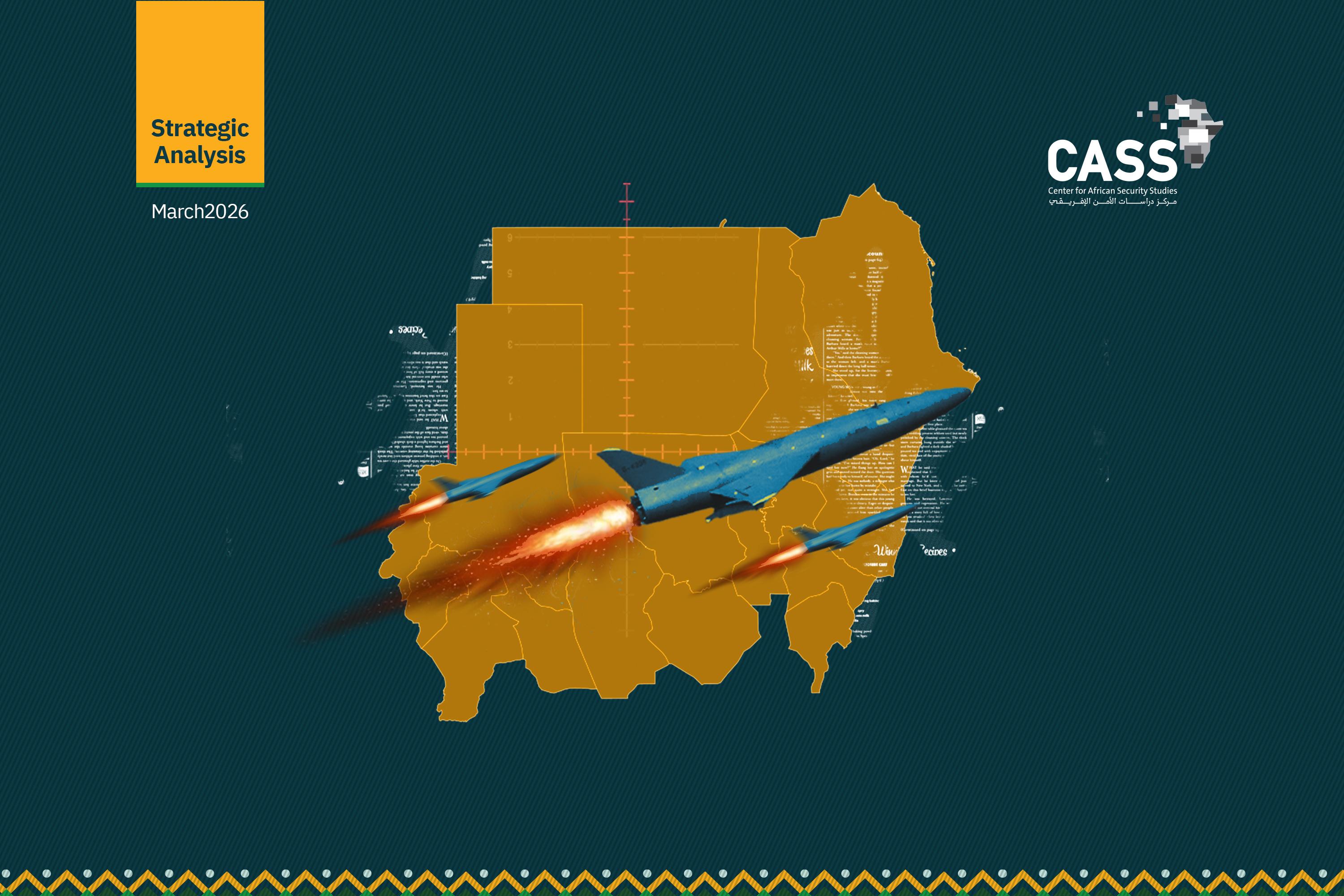
Since war broke out in April 2023 between the Sudanese army and the paramilitary Rapid Support Forces (RSF), there has been a major shift in the weapons used by both sides. As early as the following year, the conflict evolved from a traditional urban war, relying on armor and heavy artillery, to a low-cost, high-impact war of attrition waged by drones.
The types of drones used reflect the nature of undeclared regional alliances. The Sudanese Armed Forces (SAF) have regained the initiative around Omdurman and Khartoum by deploying medium-altitude, long-endurance drones including the Iranian Qods Mohajer-6 and the Turkish Bayraktar TB2, which had already proven their effectiveness in multiple theaters of combat.
These platforms are distinguished by their ability to perform dual missions: armed reconnaissance combined with firing precision-guided munitions against moving or stationary targets.
By contrast, the RSF has used modified commercial drones and lightweight First-Person View (FPV) loitering munitions or “suicide drones,” as well as developing its ability to drop small bombs with relative accuracy on army positions, particularly around fixed bases in Darfur and Kordofan.
This asymmetry in drone capabilities has created a fluid combat environment in which neither side has complete control of the skies.
The most prominent manifestation of this shift was in the battle for Omdurman in early 2024, in which the SAF used drones to identify and target RSF convoys in open urban areas, well before they reached the front lines. Precision airstrikes significantly reduced the paramilitary’s ability to maneuver freely, forcing it to adopt decentralized deployment tactics.
In the state of Al-Jazirah, the SAF targeted field operations rooms in residential neighborhoods, reflecting an increasing reliance on real-time reconnaissance and use of drones to identify the coordinates of targets prior to strikes.
Attacks also targeted vital infrastructure, such as the Al-Jaili refinery north of Khartoum, a development that reflected the war’s shift from targeting purely military assets to hitting economic infrastructure.
In contrast, the RSF used suicide drones to target gatherings of army personnel and supply depots. It carried out attacks with small aircraft carrying improvised explosive devices (IEDs), which disrupted the army’s conventional lines of defense and forced it, too, to disperse its stockpiles and equipment across multiple locations in order to minimize its losses.
The Impact of Drones on the Course of the Battle
Drones have effectively made impossible to deploy large military convoys in Sudan. They have placed any troops or assets moving in the open vulnerable to detection and targeting within minutes. This has forced both sides to move in small groups, use camouflage, and fan out across residential areas, further complicating the humanitarian situation.
Drones have also enabled the army to conduct precision strikes against specific targets. Instead of widespread, indiscriminate bombing, the SAF became able to identify a specific target and strike it with guided munitions. This reduced the need for conventional warplanes such as MiG-29s or Su-25s, which have high operating costs and require a connected system of infrastructure.
On the other hand, the proliferation of inexpensive drones has enabled the RSF to conduct ongoing strikes to harass its adversary; even if these strikes are not militarily decisive, they psychologically and tactically exhaust the enemy.
Moreover, constant drone activity over areas of conflict creates a sense of insecurity and affects the morale of both fighters and civilians.
The low cost of drones, compared to conventional aircraft, has also enabled the warring parties to prolong the conflict. Furthermore, the proliferation of this technology in a fragile security environment threatens to see them transferred to uncontrolled actors, threatening regional stability more broadly.
Drones have provided the military with an early warning system to protect its military bases, allowing for the detection of any buildup of RSF troops before they reach the perimeter walls. This has helped prevent the fall of some strategic locations.
Conversely however, the war has revealed the vulnerability of Sudan’s economic infrastructure to small suicide drones. A drone costing only a few thousand dollars can target a power station or fuel depots, causing millions of dollars in damage and have an untold impact on civilian lives.
Conclusion
Cheap drones have “democratized” modern conflicts, and Sudan provides a classic example. Even though one side has relatively advanced drones, while the other relies on innovative, low-cost solutions, both are capable of having a real impact on the ground.
Accordingly, the decisive variable in the next phase may not be the number of drones, but rather the ability to jam their electronics and them shoot down enemy aircraft. In this way, superiority in electronic warfare systems could determine who effectively controls the skies. Should either side acquire advanced technological support in this area, the balance could shift rapidly.
In this sense, Sudan today constitutes a living laboratory for the transformation of warfare in Africa. It represents a war that is less costly in terms of resources, but more complex in terms of results, and with a broader impact on both society and the state.