
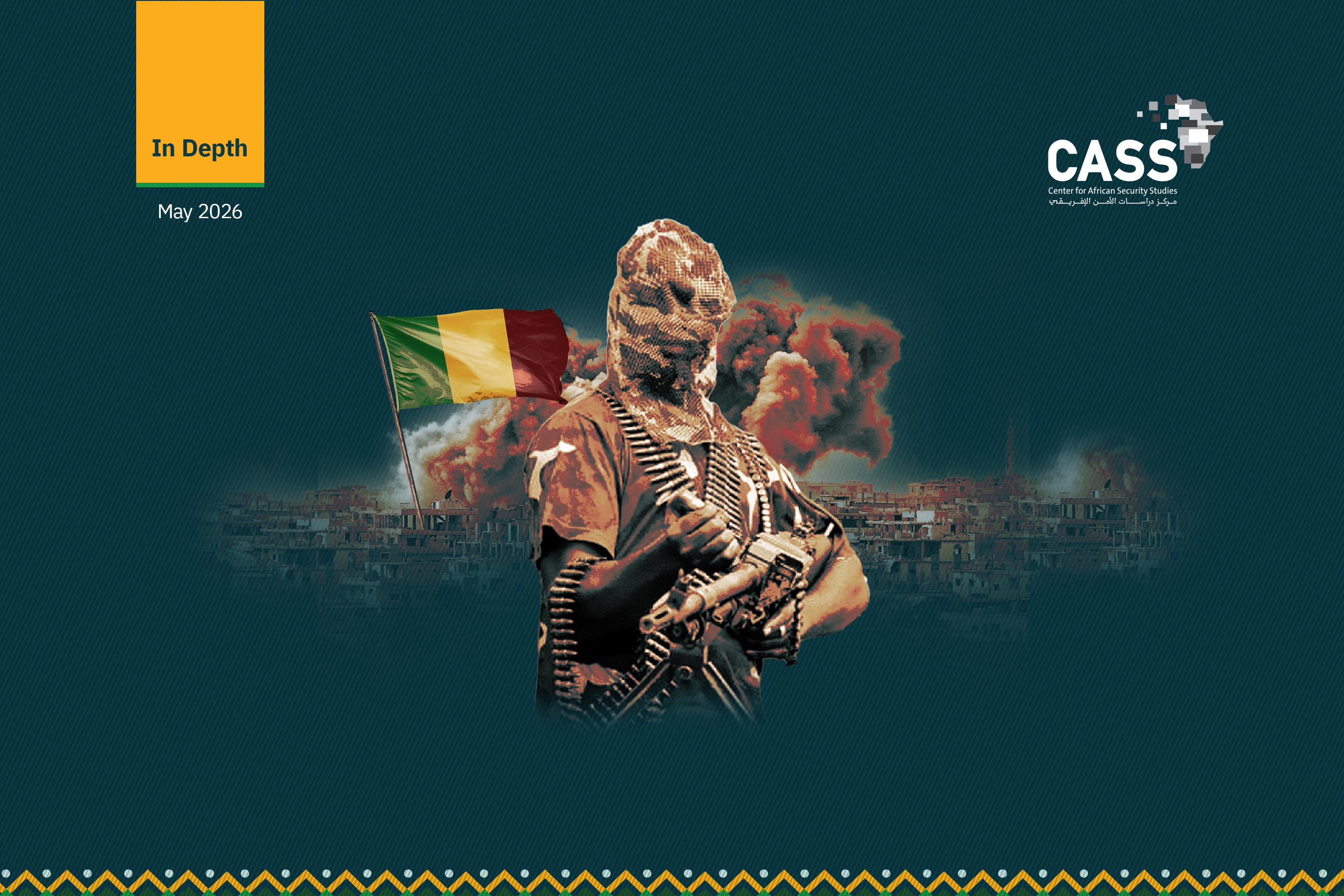
Mali is experiencing its most dangerous security and military escalation in years, following a series of large-scale and coordinated attacks carried out by Jama'at Nusrat al-Islam wal-Muslimin (JNIM), the al-Qaeda-affiliated group, in cooperation with Tuareg armed factions, against military installations and strategic sites in the capital Bamako and a number of northern and central cities.
The current wave of escalation began to emerge publicly in late April 2026, before expanding in the days that followed to include the targeting of supply lines leading to the capital, the execution of ambushes and attacks on commercial and military convoys, and a concurrent surge in attacks across central and northern parts of the country.
The most significant development was the armed groups' ability to shift the battlefield from remote peripheries to the outskirts of the capital Bamako — a shift of considerable sensitivity in the Malian context, given that Bamako had remained relatively insulated from the level of threat witnessed in the north and center of the country in recent years.
The attacks targeted military bases and strategic facilities, including sensitive camps linked to the military command, as well as vital supply routes coming from Senegal and Côte d'Ivoire — a clear attempt to demonstrate the armed groups' capacity to strangle the capital economically and security-wise.
The escalation came at a time when Mali is undergoing a complete reshaping of its security and political system, following years of military coups and tension with Western powers, particularly France. Since Colonel Assimi Goïta's rise to power, Bamako has moved to end the French military presence and curtail the role of the UN mission, while expanding cooperation with Russia and the Africa Corps — formerly linked to the Wagner Group.
The military authority presented these shifts as the beginning of a phase of "reclaiming sovereignty" and ending the security failures that accompanied the Western presence. However, recent developments have shown that armed groups still retain a high capacity for maneuver and reorganization.
What is particularly notable about the recent attacks is that they were not merely conventional hit-and-run operations; they bore the hallmarks of coordinated, multi-front military operations, indicating a clear advance in the level of planning, communications, and coordination between jihadist groups and Tuareg armed factions. Furthermore, the establishment of checkpoints on some roads leading to the capital and the targeting of supply convoys reflects a shift by armed groups toward a strategy of "pressure on the center," rather than merely consolidating control over the peripheries.
This development carries significant political and military implications, as it aims to expose the fragility of the state and the military authority's inability to secure the vital space surrounding the capital.
The immediate impact of the escalation has been substantial at both the security and political levels. The attacks prompted the Malian leadership to take exceptional measures, most notably Colonel Goïta personally assuming the defense portfolio — a move that reflects the depth of the crisis within the military institution.
Security alert levels in Bamako have risen sharply, and public fears of the attacks spreading toward the capital and its surroundings have grown, in tandem with disruption to trade and transportation movements, and mounting concerns over supply shortages and rising prices. At the military level, the attacks exposed the continued weakness of the army's capacity to secure vast swaths of the country despite intensive Russian support, while also revealing the fragility of supply lines and military communications.
Looking further ahead, perhaps the most dangerous aspect of current developments is the possibility of reproducing the "exhausted state" model that Mali experienced following the 2012 collapse — but in a far more complex environment. The al-Qaeda-affiliated groups are now more experienced and organized, and their cooperation with certain Tuareg factions endows them with a local and ethnic dimension that transcends the traditional jihadist framing.
Should this convergence persist, the military authority may face growing difficulty in restoring control over the north and center — particularly given the retreat of traditional international support and Bamako's near-total reliance on a military-centric approach.
The continued security deterioration could also produce far-reaching regional repercussions, as Mali represents the security center of gravity in the Sahel region. Any further collapse there will directly affect Burkina Faso and Niger — both of which already face fragile security conditions — potentially opening the door to a broader cross-border expansion by armed groups.
In light of current circumstances, several possible scenarios present themselves. The first involves the military authority succeeding, with Russian support, in containing the escalation through large-scale military operations and re-securing the capital's perimeter and supply lines. This scenario is possible, but requires field capabilities and internal stability that do not currently appear to be fully in place.
The second scenario — the most likely in the medium term — involves the continuation of a war of attrition, in which armed groups sustain sporadic but coordinated attacks aimed at exhausting the army and eroding the authority's prestige, without directly seizing the capital.
The most dangerous scenario, however, remains the expansion of the alliance between jihadist groups and separatist factions, resulting in the formation of a broad armed front that pushes the country back toward a state of comprehensive collapse reminiscent of what it experienced more than a decade ago.